Rebooting for Earth Day: Digital’s Role in Sustainability
Earth Day 22 April 2026

Summary
Earth Day is a moment to reflect on our impact on the planet and to commit to positive change.
Earth Day is a moment to reflect on our impact on the planet and to commit to positive change. We often think about switching off our lights at home, but in today’s world, our digital footprint is just as significant. In my position, it's a perfect opportunity to think about the energy usage and carbon emissions of our digital world and explore how we can work towards a more sustainable future.
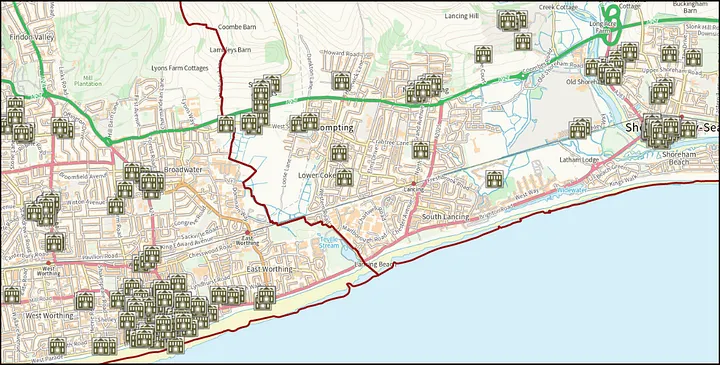
There are some fantastic groups, initiatives and projects happening across Adur & Worthing driving change for our communities and the planet. I’ve been on beach cleans with Keep Lancing Lovely, visited Climate Resilience Centre Worthing (CREW), and seen the huge positive impact SussexBay is having to our blue spaces.
The councils has also made a carbon neutral commitment, and I would like to see our Digital service plays a role in achieving these targets.
The Hidden Energy of the Digital World
We might not see it, but every email, every stored file, every online meeting contributes to energy consumption. Data centers hum with activity, processing and storing information, requiring vast amounts of electricity. The proliferation of cloud services and AI, while offering numerous benefits, also raises questions about energy usage and environmental impact.
To gain better insight into our digital carbon footprint, the Digital team at Adur & Worthing Councils is starting to monitor the carbon footprint dashboards provided by key service providers. Google Workspace offers a dashboard that allows us to track the carbon emissions associated with our use of their services. Similarly, Amazon AWS Carbon Footprint tool monitors the environmental impact of our cloud infrastructure. These tools provide valuable data, allowing us to identify areas where we can optimise and reduce our energy consumption.
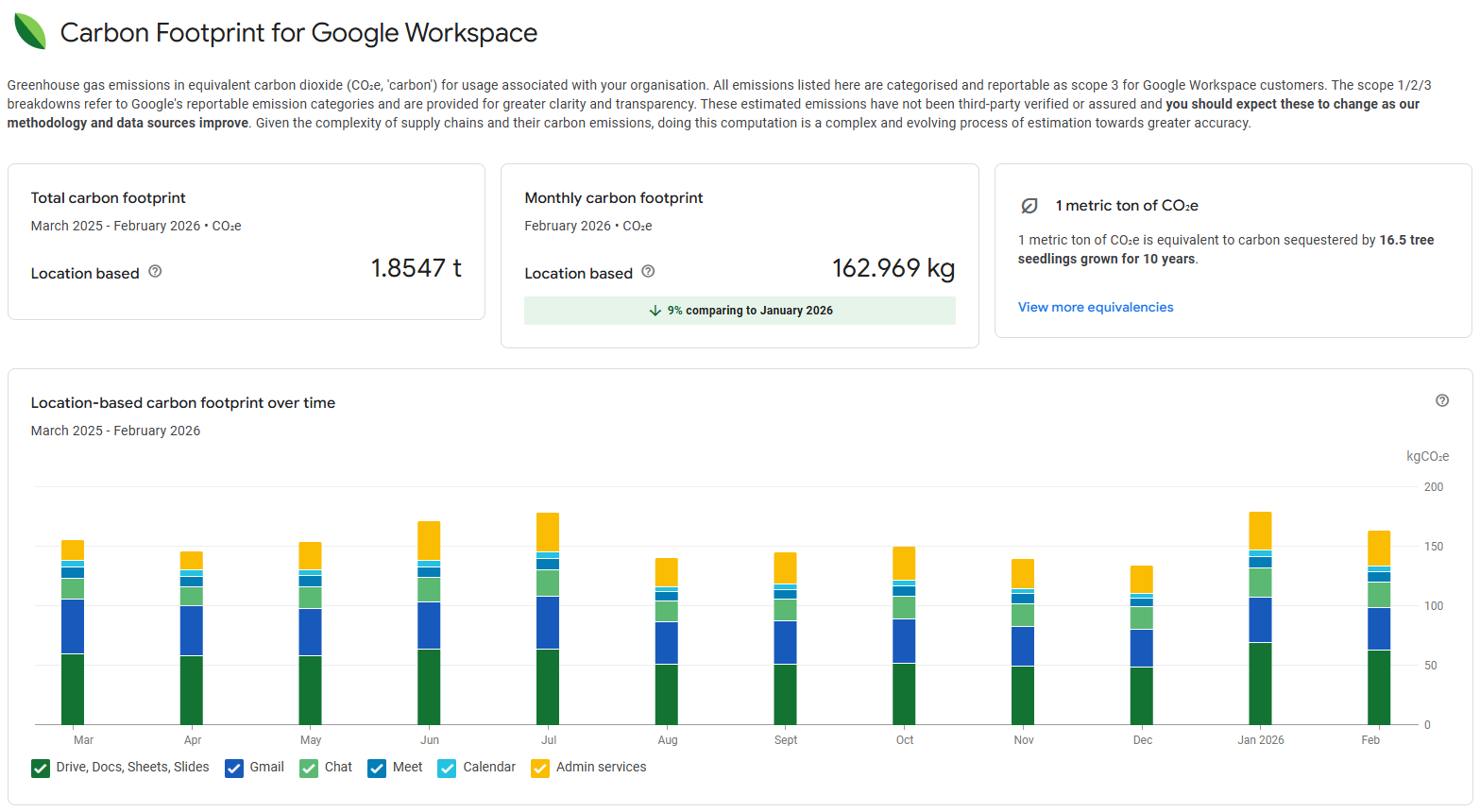
Screenshot: Google Workspace Carbon Footprint reporting
This level of oversight is crucial. By understanding the emissions associated with our digital operations, we can make informed decisions and implement strategies to minimise our impact. It’s about holding ourselves accountable and actively working towards a more sustainable digital environment.
Using tools like Greenhouse Gas Equivalencies Calculator we can show that our Google Workspace usage over the past 12 months produces an equivalent carbon footprint as driving 4,723 miles in a petrol-powered car, for example.
The Rise of AI and its Energy Demands
The digital landscape is constantly evolving, and Artificial Intelligence (AI) is at the forefront of this transformation. We are starting to explore the potential of Google Gemini, which offers exciting possibilities for improving our services and streamlining operations. However, this innovation comes with a cost – a significant energy and water demand.
AI models, or large language models, such as Gemini, require vast computational power to train and operate. The complex algorithms and massive datasets involved necessitate energy-intensive processing, which translates into a considerable carbon footprint. This presents a critical trade-off: innovation versus power usage.
As we integrate AI into our services, we must be mindful of this energy demand and seek ways to mitigate its impact. This involves exploring energy-efficient AI models, optimising algorithms, and leveraging renewable energy sources to power our digital infrastructure. The goal is to harness the benefits of AI while minimising its environmental cost.
Data Centers: The Engine Rooms
Data centers are the engine rooms of our digital world. They power everything from email servers to cloud storage to AI computations. These facilities consume significant amounts of energy, primarily for powering servers and keeping them cool. While traditional cooling methods can be very energy intensive, the data center industry is increasingly aware of its environmental impact and some are exploring innovative solutions to improve energy efficiency.
To actively reduce this environmental impact, some modern data centers are evolving not just in how they use power, but where that power comes from.
Some key sustainable advancements include:
-
Renewable Energy Integration: A critical step in modernising data centers is exploring opportunities to power digital infrastructure directly with renewable energy sources. It is becoming increasingly important to work with cloud providers who share a commitment to sustainability and actively invest in renewable energy to power their operations.
-
Strategic Location: Building data centers near renewable energy sources, or in cooler climates, drastically reduces the reliance on fossil fuels and energy-intensive cooling systems.
-
Advanced Cooling Techniques: New ways of handling cooling are emerging to further drive down energy consumption. This includes "free cooling," which utilises outside air when the temperature is appropriate, and "liquid cooling," which uses liquids with a higher heat capacity than air to cool servers more efficiently.
These advancements across both green energy usage and facility cooling are crucial for reducing the overall carbon footprint of our digital services. We must stay informed about the latest technologies and advocate for sustainable data center practices.
The scale and need for these centres is huge, with over 500 in the UK. I was shocked on a holiday to Malaysia last year to read about a new 22-acre “hyperscale” data centre campus being built near the border with Singapore.
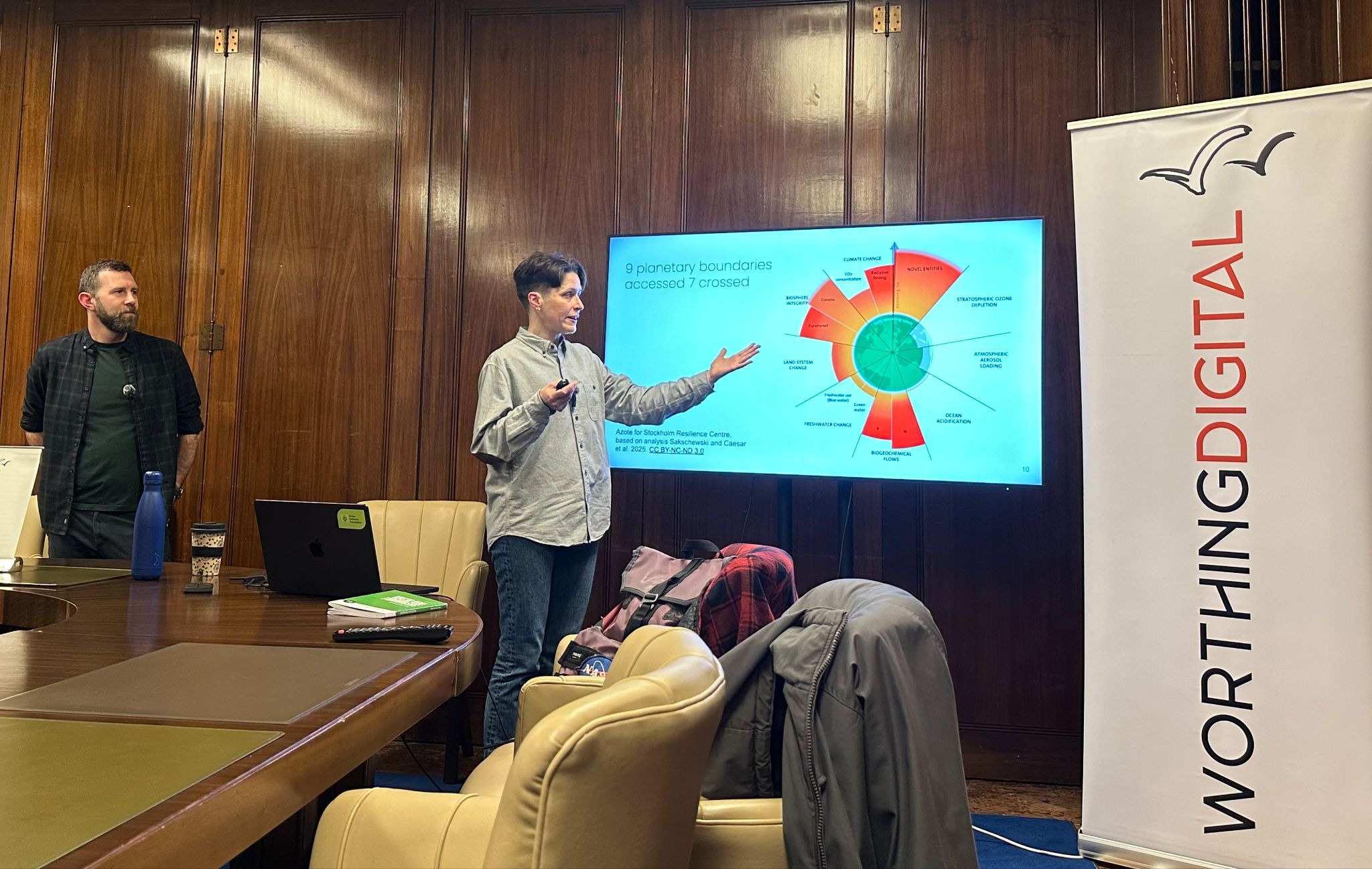
We recently welcomed Green Software Brighton to give a fantastic WorthingDigital Talk at Worthing Town Hall about green software and digital sustainability. It was a real lightbulb moment that others are leading on this and we need be part of it.
Balancing Innovation and Sustainability
The challenge we face is how to balance the drive for innovation with our commitment to sustainability. We want to leverage the latest technologies to improve our services to the residents of Adur and Worthing, but we must do so in a way that aligns with our carbon neutral goals.
Some our key considerations:
-
Energy Efficiency: Prioritise energy-efficient technologies and practices in all our digital operations.
-
Renewable Energy: Explore opportunities to power our digital infrastructure with renewable energy sources.
-
Data Optimisation: Reduce the amount of data we store and process, where possible. Implement data retention policies and archive data that is no longer needed.
-
Cloud Provider Responsibility: Work with cloud providers who share our commitment to sustainability and invest in renewable energy.
-
Awareness and Education: Raise awareness among our staff and the community about the environmental impact of digital technologies and promote sustainable digital practices.
A Moment for Reflection and Action
Earth Day is more than just a passing moment. It’s a time to reflect on our impact on the planet and to commit to positive change. It’s a reminder that even small actions can make a big difference.
By taking time during Earth Day to think about the energy usage and carbon emissions of our Digital service, we can identify areas for improvement and develop strategies for a more sustainable digital future. By monitoring our carbon footprint using the Google Workspace and Amazon AWS tools, and by considering the implications of AI and data center energy use, we are taking important steps in the right direction.
Our pledge to be carbon neutral by 2030, and the wider ambition of Net Zero for Adur and Worthing by 2045, will take continuous effort and adaptation. As our digital world expands, so too does our responsibility to minimise its impact. Earth Day offers us the chance to consider our role, and to plan for a future where technology and sustainability go hand-in-hand.