Is Agentic Engineering the answer for Public Services?
Summary
We say Vibe Coding is dead because there is already a superior replacement, one that is truly disruptive… Agentic Engineering.
Many posts will tell you “Vibe Coding” is dead. A concept so new that many haven’t even heard of it yet. Coined in early 2025 and quickly becoming the Collins English Dictionary Word of the Year, Vibe Coding is the recent trend of casually generating entire applications on the fly using AI and natural language prompts, without deep technical knowledge. You test it, and you iterate based on the “vibes” or how it feels. It’s a practical way to knock together a quick prototype or test a new idea, but it’s controversial.
Relying purely on vibes leads to three failures:
- It can scale security vulnerabilities rapidly because the code isn’t thoroughly reviewed.
- It creates tangled and unmaintainable architecture.
- It suffers from “context collapse,” where the AI simply forgets earlier design decisions during long sessions.
You wouldn’t build a critical public service based on vibes. So, while we might say Vibe Coding is dead, there is already a superior, truly disruptive replacement: Agentic Engineering.
What is Agentic Engineering?
While Vibe Coding might be the quick and dirty way to knock together a working app, Agentic Engineering treats AI like a structured development team. It is the practice of using multiple specialised AI agents with distinct roles, boundaries, and “skills” to collaboratively design, build, and maintain software.
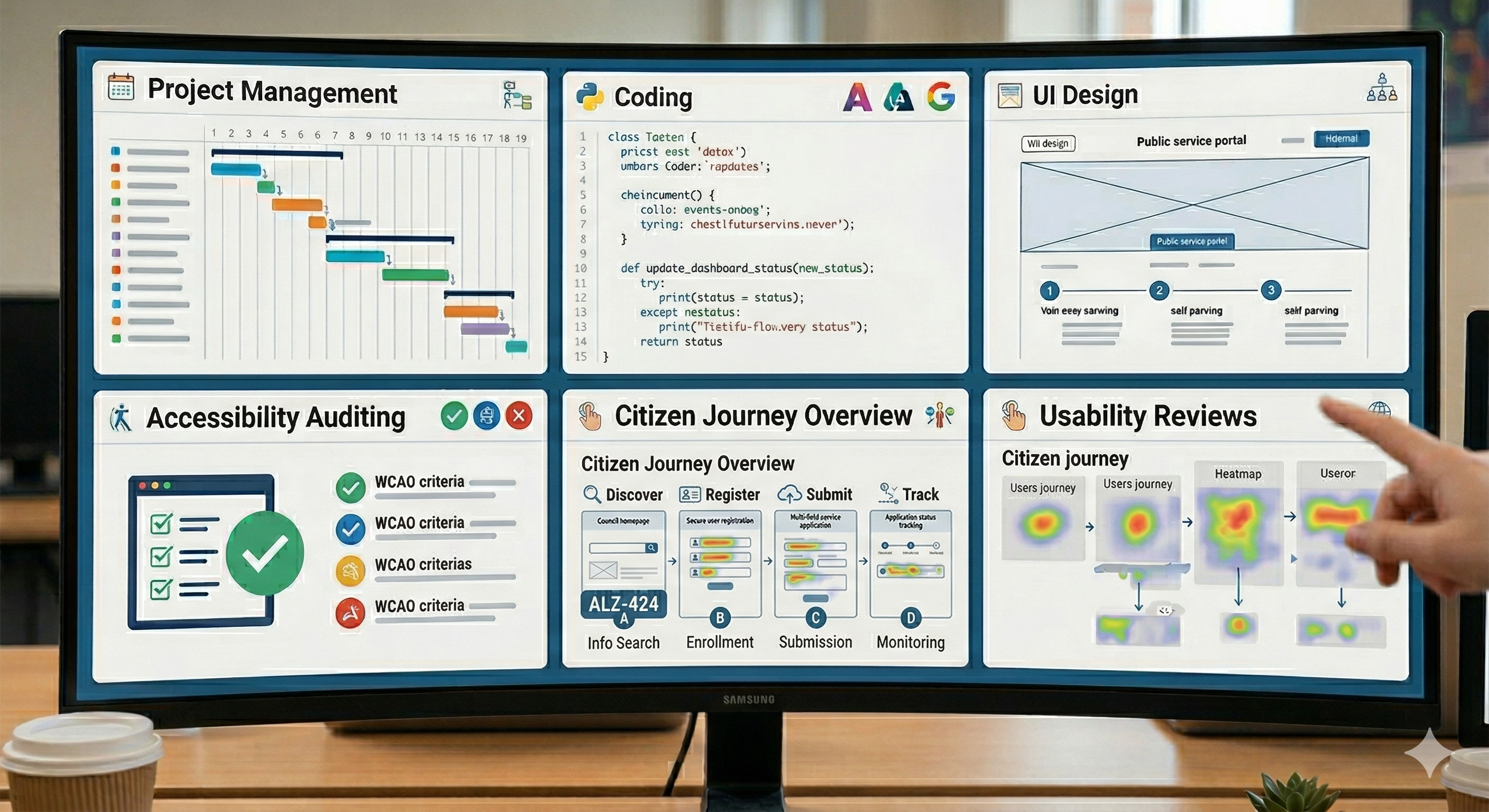
Instead of asking one AI to “build a portal”, Agentic Engineering involves a project management agent scoping the work, a coding agent writing the logic, a UI agent designing the interface, and automated testing agents checking the output. The key factor, however, is the human driving and sense-checking the process.
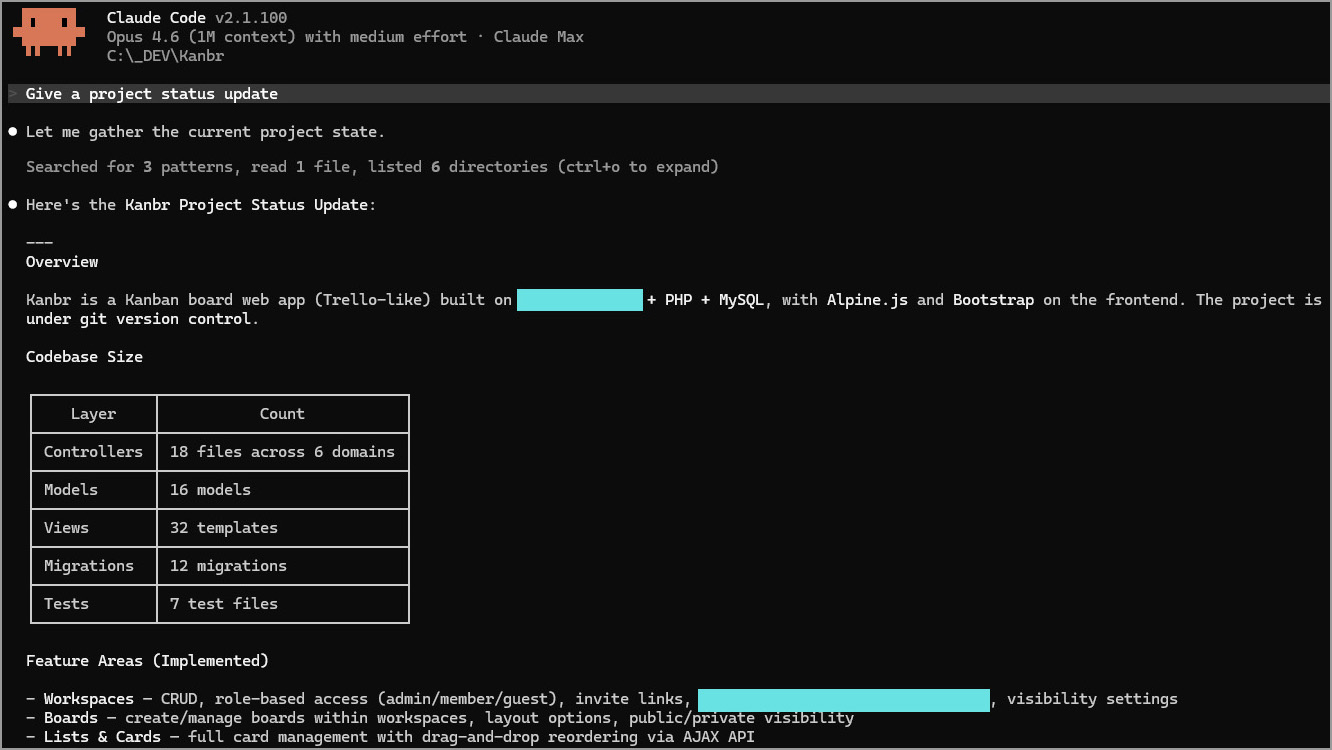
Sometimes the only way to build a true understanding and cut through the hype is to just do it. So, I’ve excitedly been spending my spare time experimenting and building with Anthropic’s Claude Code and Google’s Gemini Antigravity. It is highly addictive if you love coding. It has opened my mind to how we might one day transition digital service development and manage risks in this changing AI era.
Prompting as Philosophy: Opening Development to New Voices
A revolutionary aspect of this shift is how it opens software development to entirely new disciplines. Catherine Howe, Chief Executive of Dorset Council, recently wrote a thought-provoking article, It’s all about the question, where she discusses prompting as a form of philosophy. It is not just about asking AI to “build it”; it is about the structure and the conversation.
If coding is transitioning from typing syntax to framing precise, philosophical questions, this could be how we bring entirely new skill sets into software development. Subject matter experts, frontline workers, service designers, and accessibility advocates can directly influence the logic and flow of digital services through natural language. This could bridge the gap between frontline service delivery and backend engineering.
While it remains critical to have skilled developers review the output, could “pair programming” between a frontline worker and a digital developer be a viable option in this scenario?
Risk, Reality, and the Human
There is a natural apprehension about letting Generative AI write production code for public services. David Chismon, CTO for Architecture at the National Cyber Security Centre, recently touched on the cybersecurity aspects of this in his post, Vibe check: AI may replace SaaS, but not for a while. The risks of vulnerabilities or hallucinations are very real.
However, we can now practically mitigate AI coding risks through structured environments:
- Existing Code Frameworks: AI doesn’t have to build from scratch. One of the best mitigations I’ve found is confining agents to work within established, secure, and standardised coding frameworks. This brings immediate structure and safety to the generated code.
- The Human in the Loop: Developers don’t disappear; their roles elevate. They transition from writing code from scratch to reviewing, orchestrating, and guiding their AI teammates. They are the essential safety net.
- Specialised Agentic “Skills”: We can reduce risk by assigning multiple agents to manage different, specific skills. These skills are essentially playbooks or files that provide specific domain knowledge and guardrails.
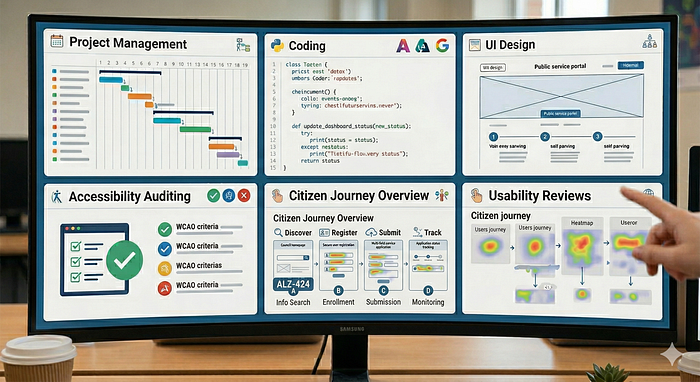
Examples in action:
- Accessibility Auditing: We can deploy agents to automatically audit our user interfaces against strict WCAG 2.2 AA standards, ensuring keyboard navigation and screen reader compatibility are perfect before a human even reviews the code.
- Usability and Design System Reviews: AI personas can simulate everyday citizens interacting with our services, highlighting friction points and confusing navigation paths to align our interfaces with GDS research.
- Security Scans: Dedicated security agents can run continuous vulnerability checks, ensuring public data remains safe and secure.
When structured this way, is it really any more risky than letting human developers build from scratch?
Productising and Overcoming Tech Debt
Of course, generating code this quickly brings the risk of massive technical debt. To overcome this, teams must establish strong specifications and standardise platform architecture. This acts as a strict contract that the AI cannot deviate from. Coupling this with robust source code version control ensures that every change is tracked, reviewed, and easily reversible.
To make this work securely and sustainably for local government, we need to think about standardising a platform to host or build into. Imagine a productised Local Government AI Coding Platform. Something like Cursor AI for local gov. Where councils can spin up pre-trained agents tailored specifically to public sector standards, like the GDS Design System.
This approach provides definite benefits:
- Overcoming Tech Debt: AI agents excel at reading, documenting, and refactoring legacy code. They can help untangle years of technical debt much faster than a human team ever could.
- Source Code Version Control: Unlike locked-in from some existing platforms, Agentic Engineering generates raw, portable code. This allows us to utilise proper source code version control (like Git), ensuring full transparency, auditability, and easy rollbacks.
Imagine standardising this capability across the UK. Building on the ethos of the Local Digital Declaration and collaborative projects like LocalGov Drupal, councils could share a central repository of AI “Gov-Skills.” It could be a tuned, legally compliant accessibility agent, shared nationally to build the software we know we need.
Could this become an additional part of the common architecture platform for local government, that Phil Rumens, Principal Technologist, GDS is leading on?
Disrupting the Supplier Landscape
At Adur & Worthing Councils, our previous director, now CEO Paul Brewer, took a bold step nearly a decade ago to escape the clutches of legacy IT systems by adopting a low-code development platform. That shift empowered a small internal team to build everything from waste management apps to emergency community support systems during the pandemic. It has been a massive success, delivering financial savings and improved user experiences, though we do still stumble with some persistent legacy systems.
Agentic Engineering will spark innovation and transformation within councils, but it also has the power to disrupt the wider market. AI drastically lowers the cost of building internal dashboards, workflow tools, and simple applications, the default assumption that buying an off-the-shelf SaaS product is cheaper than building it in-house is no longer the given.
For councils willing to manage the risks and make educated decisions, we will no longer have to accept poor user experiences. We can deploy AI agents to rapidly build, test and iterate bespoke, highly accessible front-end interfaces that perfectly suit our local communities.
This tech shift might finally force large legacy suppliers to create better (I dream), user-led software, or risk being bypassed entirely by agile councils building their own agentic solutions.
The New Talent
In March 2026, NVIDIA CEO Jensen Huang stated that he would be “deeply alarmed” if an engineer didn’t consume at least half their salary’s value in AI tokens annually. Using those tokens to fuel the AI agents, with the human developer acting as the director gives massive productivity gains. Huang is talking about a new standard for productivity, giving teams superhuman abilities.
For Adur & Worthing Councils, and the wider public sector, Agentic Engineering isn’t about replacing our teams. It’s about enabling these new abilities to deliver the user-centred digital services that the public deserves.